The Routledge International Handbook of Morality, Cognition, and Emotion in China

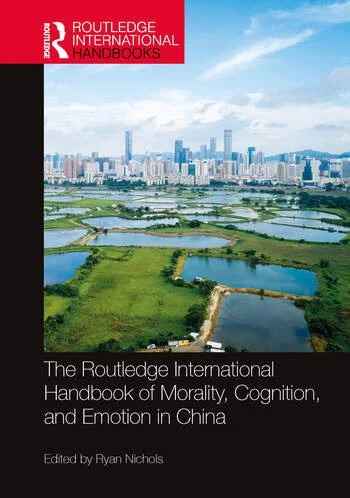
Cover of The Routledge International Handbook of Morality, Cognition, and Emotion in China, edited by Ryan Nichols


Routledge, 2022

This volume was the product of generous funding from the Templeton World Charity Foundation, which allowed the authors, who come from many very different disciplines and use quite distinct methods, to meet, read, comment on, and discuss our draft papers. Those disciplines range from philosophy, linguistics, history, and law to anthropology, social and developmental psychology, behavioral ecology, and neuroscience. The book's fifteen chapters study morality at the level of the individual person, and together they move past the familiar Western picture of China as a single, monolithic culture. Among the questions they take up: What are the major contours of a distinctively Chinese morality? What role did ancient ecology, climate, and pathogen load play in shaping Chinese moral attitudes and emotions? Are the ingredients of a good life in China different from those elsewhere? How are children in China morally educated? What can cultural neuroscience tell us about how people in China and elsewhere treat family members and strangers?

The chapters move from models, through distal and subpersonal factors, to cultural and historical factors, development, and moral change. Michael H. Bond proposes a social psychological model of the situated morality of the Chinese and other cultural groups. Takeshi Hamamura analyzes Chinese morality in light of latitude, pathogens, agriculture, and modernization, and Shihui Han brings cultural neuroscience to bear on moral judgment in East Asia. Edward Slingerland draws on cognitive science to defend habit in early Confucian virtue ethics, Perry Link examines language and morality in Chinese culture, and Yunxiang Yan traces trajectories of moral transformation in contemporary China. Jeffrey Wasserstrom asks whether the Hong Kong protests carry on, or break from, the ethics of protest in historical China. Chapters by Yiyi Wang and Yanjie Su, John Head, Liqi Zhu and Yingjia Wan, Jing Xu, Emma E. Buchtel, Vivian Lun, and Yiming Jing and Huajian Cai take up genetics, law, moral development, the meaning of morality in Chinese and in China, well-being, and the cultural diversity of Chinese morality. My own opening chapter makes the case that multidisciplinary research is essential to understanding Chinese morality. 


Advances in Religion, Cognitive Science, and Experimental Philosophy


Bloomsbury Publishing, 2016

Helen De Cruz and I partnered to edit this volume of boundary-pushing papers that range across inferential terrain between cognitive science of religion and philosophy. Cognitive science of religion examines the cognitive bases of religious beliefs and practices. Its research encompasses the range and contents of religious beliefs across cultures, representations of supernatural beings and their effects on prosocial and between-group behavior, cognition of personhood and embodiment, and much more. We believe that results in cognitive science ought to inform philosophical discussions of religion and religious belief. This is for the simple fact that philosophers of religion make a variety of empirical claims—about the naturalness of theism and the effects of religious belief on moral behavior, to name two. 

Though most philosophers have been slow to account for empirical evidence that challenges their a priori work in religion, this volume features contributions by psychologists, philosophers and interdisciplinary researchers that apply data from the psychology of religion to important problems in the philosophy of religion. Problems discussed in this book include the psychology of religious diversity, the psychology of substance dualism, the problem of evil, and the relation between religious belief and empathy—and the cognitive science explaining the formation of intuitions that unwittingly guide philosophers of religion when formulating arguments. We are proud to have such outstanding researchers contribute to our volume. 

Read the Introduction → 


Philosophy Through Science Fiction

Routledge, 2008

The aim of this book is to bring philosophy to a wider audience of intelligent, exploratory thinkers who will appreciate situating canonical big questions in the context of the future and the past. In addition to a substantive introduction to the major arguments and positions, each of the seven chapters (philosophical method and disagreement, knowledge and skepticism, free will, spacetime and time travel, the mind, personal identity, and religion and God) contains a science fiction story, an excerpt of an important historical work, and a contemporary piece. 

Here are two examples. The religion and God chapter includes a thorough, 8,000-word discussion of the arguments, an excerpt of David Hume on the design argument, a paper written by leading philosopher of religion Stephen Wykstra on the argument from evil, and Ted Chiang's must-read "Hell is the Absence of God." The knowledge and skepticism chapter includes a thorough introduction to types of skepticism, foundationalism, closure principles, and fallibilism, and is followed by Plato's allegory of the cave, Descartes' Meditations 1 and 2, a brilliant piece on Nick Bostrom's simulation argument by Alistair Richmond, and an essential short story from Philip K. Dick called "We Can Remember It for You Wholesale." I rewrote this book from an earlier, dated version called Thought Probes, edited by Nick Smith and Fred Miller. 


Thomas Reid's Theory of Perception

Oxford University Press, 2007

Thomas Reid is clearly one of the most important philosophers from the 18th century, as the great renewal of interest in his philosophical writings partially testifies. Reid’s impact has been felt most keenly in the contemporary analyses of the structure of knowledge, the nature of freedom and agent causation, and in specialized topics in the philosophy of perception. My aim writing this book was to provide a thorough, unified account of Thomas Reid’s work on the mind in its historical context, and to assess his theory's philosophical significance. 

If you want to read just one chapter, I recommend reading Chapter 9, a standalone chapter, about the Molyneux problem. Suppose someone was born blind but as an adult is given sight through a surgical procedure. Just before the bandages are removed and she takes a first look at the world, imagine someone has placed in the room a cube and a sphere for her to look at. The Molyneux problem refers to the conflict that natural philosophers of the 18th century had in anticipating whether or not this person would be able to tell, without touching them, which is the cube and which is the sphere. I recommend dipping into this chapter because it illustrates the subtle differences of philosophical methodology between empiricists and rationalists emerging in the 17th and 18th centuries. 


Read the chapter about the Molyneux problem (PDF) →