Publications
Books
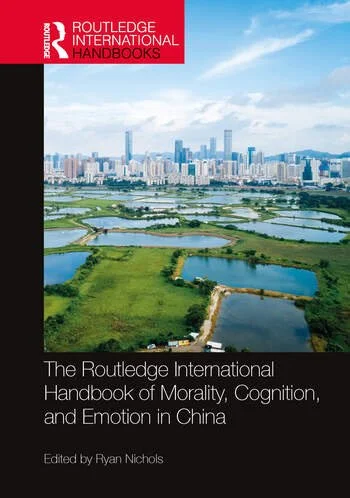
Nichols, R. (Ed.). (2023). Zhongguoren daode tixi de wenhua yanjin 中國人道德體系的文化演進 [The cultural evolution of the Chinese moral system] (Y. Zhang, A. Hsieh, A. Hao, & J. Xu, Trans.). Ainosco Press. https://doi.org/10.978.986437/2058 (Original work published by Routledge, 2022.)
Nichols, R. (Ed.). (2022). The Routledge international handbook of morality, cognition, and emotion in China. Routledge. https://doi.org/10.4324/9781003281566
De Cruz, H., & Nichols, R. (Eds.). (2016). Advances in religion, cognitive science, and experimental philosophy. Bloomsbury Academic. https://doi.org/10.5040/9781474223812
Nichols, R., Smith, N. D., & Miller, F. (2008). Philosophy through science fiction: A coursebook with readings. Routledge.
Nichols, R. (2007). Thomas Reid’s theory of perception. Oxford University Press. https://doi.org/10.1093/acprof:oso/9780199276912.001.0001
Articles and chapters
DOI links go to the published version; PDF links go to the author’s copies on this site. An asterisk (*) marks work that was not peer reviewed. Data and appendices for the text-analytic studies are on the Data page.
In press
Nichols, R. (in press). The Sino-Jesuit encounter: From understanding to explanation. Sino-Platonic Papers.
Nichols, R., Wagoner, J., & Durkee, P. (in press). Coalitional formidability and kinship across three cultures: Experimentally assessing implications of inclusive fitness and reciprocal altruism. Human Nature.
Submitted and in preparation
Ni, Q., Zhao, X., Nichols, R., & Moll, H. (2026). Of minds and grains: Comparing cognitive style in young children from rice-growing and wheat-growing regions of China and the US [Manuscript in preparation].
Nichols, R., & Wagoner, J. (2026). Responsibility, free will, karma, and causation: Cross-cultural experiments with Mahāyāna and Theravāda Buddhist sampling [Manuscript in preparation].
Nichols, R., & Wagoner, J. (2026). Causal exclusion and scientific reasoning across seven cultures [Manuscript submitted for publication].
2025
Lim, D., Nichols, R., & Wagoner, J. (2025). The presumption of compatibilism. Religious Studies, 61(S1), S135–S153. https://doi.org/10.1017/S0034412525000113
Nichols, R. (2025). Cross-cultural variation in cognitive style: A review of findings, replications, and implications. Journal of Cultural Cognitive Science, 9(1), 175–191. https://doi.org/10.1007/s41809-025-00166-w
Bingenheimer, M., Brody, J., & Nichols, R. (2025). Experiments in distant reading: Using topic modeling on Chinese Buddhist texts from 500–800 CE. Digital Humanities Quarterly, 19(1). https://dhq.digitalhumanities.org/vol/19/1/000771/000771.html
Chen, C., Nichols, R., & Moyzis, R. K. (2025). Culture-biology dualism: Diagnosis and treatment. In M. J. Gelfand, C.-Y. Chiu, & Y.-Y. Hong (Eds.), Handbook of advances in culture and psychology (Vol. 11, pp. 1–47). Oxford University Press. https://doi.org/10.1093/9780197801901.003.0001
Lim, D., Nichols, R., & Wagoner, J. (2025). Experimental philosophy of free will and the comprehension of determinism. Review of Philosophy and Psychology, 16(2), 697–723. https://doi.org/10.1007/s13164-024-00726-z
2024
Nichols, R., Charbonneau, M., Chellappoo, A., Davis, T., Haidle, M., Kimbrough, E. O., Moll, H., Moore, R., Scott-Phillips, T., Purzycki, B. G., & Segovia-Martin, J. (2024). Cultural evolution: A review of theoretical challenges. Evolutionary Human Sciences, 6, Article e12. https://doi.org/10.1017/ehs.2024.2
2023
Nichols, R., & Jones, N. (2023). Holistic cognitive style, Chinese culture, and the Sinification of Buddhism. Res Philosophica, 100(1), 93–120. https://doi.org/10.11612/resphil.2263 (Invited article.)
2022
Nichols, R. (2022). The institution as an explanatory mechanism in cultural evolution: A review of three theories. Journal of Cognition and Culture, 22(5), 499–513. https://doi.org/10.1163/15685373-12340148
Nichols, R., & Moll, H. (2022). Introducing this special issue. Journal of Cognition and Culture, 22(5), 383–389. https://doi.org/10.1163/15685373-12340140
Smith Chowdhury, L., Zhang, Y., & Nichols, R. (2022). Footbinding and its cessation: An agent-based model adjudication of the labor market and evolutionary sciences hypotheses. Evolution and Human Behavior, 43(6), 475–489. https://doi.org/10.1016/j.evolhumbehav.2022.08.005
Nichols, R., Moll, H., & Mackey, J. L. (2022). How to create a cultural species: Evaluating three proposals. Philosophical Psychology, 35(2), 279–296. https://doi.org/10.1080/09515089.2021.1929915 (Response by Anton Killin and Ross Pain, https://doi.org/10.1080/09515089.2021.1980205.)
2021
Nichols, R. (2021). The status of women in Neolithic & pre-Imperial China: How bioarchaeological evidence informs ongoing debate. World Archaeology, 53(2), 273–286. https://doi.org/10.1080/00438243.2021.2021108
Nichols, R. (2021). The origin and cultural evolution of East Asian cognitive style: A case study of the Book of Changes (Yijing 易經). Journal of Cognition and Culture, 21(5), 389–413. https://doi.org/10.1163/15685373-12340118
Nichols, R. (2021). Understanding East Asian holistic cognitive style and its cultural evolution: A multi-disciplinary case study of Traditional Chinese Medicine. Journal of Cultural Cognitive Science, 5(1), 17–36. https://doi.org/10.1007/s41809-021-00075-8
Nichols, R. (2021). Footbinding, hypergamy, and handicraft labor: Evaluating the labor market explanation of footbinding. Evolutionary Psychological Science, 7(3), 315–325. https://doi.org/10.1007/s40806-020-00271-9 PDF
Nichols, R. (2021). Unfulfilled promise of cross-cultural, interdisciplinary ancient history. Journal of Cognitive Historiography, 6(1–2). https://doi.org/10.1558/jch.39458 (Response by G. E. R. Lloyd, Cambridge University.) PDF
Moll, H., Nichols, R., & Mackey, J. L. (2021). Rethinking human development and the shared intentionality hypothesis. Review of Philosophy and Psychology, 12(2), 453–464. https://doi.org/10.1007/s13164-020-00489-3 (Response by Michael Tomasello, https://doi.org/10.1007/s13164-020-00510-9.) PDF
Nichols, R., Slingerland, E., Nielbo, K. L., Kirby, P., & Logan, C. (2021). Supernatural agents and prosociality in historical China: Micro-modeling the cultural evolution of gods and morality in textual corpora. Religion, Brain & Behavior, 11(1), 46–64. https://doi.org/10.1080/2153599X.2020.1742778 PDF
2020
Moll, H., Nichols, R., & Pueschel, E. (2020). Shared intentionality shapes humans’ technical know-how. Behavioral and Brain Sciences, 43, Article e172. https://doi.org/10.1017/S0140525X20000163
Nichols, R. (2020). Systematic cognitive bias in the history of philosophy and its cultural transmission: A case study of Thomas Reid, religion, and science. Journal of Cognitive Historiography, 5(1–2), 56–86. https://doi.org/10.1558/jch.33666
2019
Nichols, R., Moll, H., & Mackey, J. L. (2019). Rethinking cultural evolutionary psychology. Journal of Cognition and Culture, 19(5), 477–492. https://doi.org/10.1163/15685373-12340070 PDF
2018
Nielbo, K. L., Nichols, R., & Slingerland, E. (2018). Mining the past: Data-intensive knowledge discovery in the study of historical textual traditions. Journal of Cognitive Historiography, 3(1–2), 93–118. https://doi.org/10.1558/jch.31662 (Volume dated 2016; issue published 29 March 2018. Reprinted as chapter 19 of A. W. Geertz (Ed.), Studying the religious mind: Methodology in the cognitive science of religion, Equinox, 2022.) PDF
Nichols, R., Slingerland, E., Nielbo, K., Bergeton, U., Logan, C., & Kleinman, S. (2018). Modeling the contested relationship between Analects, Mencius, and Xunzi: Preliminary evidence from a machine-learning approach. The Journal of Asian Studies, 77(1), 19–57. https://doi.org/10.1017/S0021911817000973 PDF
2017
Nichols, R., & Logan, C. (2017). High gods, low gods, and morality in ancient China: Developing new methods, answering old questions. In R. G. Hornbeck, J. L. Barrett, & M. Kang (Eds.), Religious cognition in China: “Homo religiosus” and the dragon (pp. 161–177). Springer. https://doi.org/10.1007/978-3-319-62954-4_11
Slingerland, E., Nichols, R., Nielbo, K., & Logan, C. (2017). The distant reading of religious texts: A “big data” approach to mind-body concepts in early China. Journal of the American Academy of Religion, 85(4), 985–1016. https://doi.org/10.1093/jaarel/lfw090 PDF
2016
Nichols, R. (2016). A sense of shame among the virtues. Journal of Moral Education, 45(2), 166–178. https://doi.org/10.1080/03057240.2016.1174677 PDF
Nichols, R. (2016). The natural history of shame and its modification by Confucian culture. In K. J. Clark (Ed.), The Blackwell companion to naturalism (pp. 512–527). Wiley Blackwell. https://doi.org/10.1002/9781118657775.ch35
2015
Nichols, R. (2015). Early Confucianism is a system for social-functional influence and probably does not represent a normative ethical theory. Dao, 14(4), 499–520. https://doi.org/10.1007/s11712-015-9464-8 PDF
Nichols, R. (2015). Civilizing humans with shame: How early Confucians altered inherited evolutionary norms through cultural programming to increase social harmony. Journal of Cognition and Culture, 15(3–4), 254–284. https://doi.org/10.1163/15685373-12342150 PDF
Nichols, R. (2015). Hypothesis-testing of the humanities: The hard and soft humanities as two emerging cultures. Southwest Philosophy Review, 31(1), 1–19. https://doi.org/10.5840/swphilreview20153111
2014
Nichols, R. (2014). Xiaodao: Yi zhong ziran zhuyi de jieshi 孝道——一种自然主义的解释 [Filial piety: A naturalistic explanation]. Studies in Philosophy of Science and Technology, 31(5), 98–106. PDF
Nichols, R., & Yaffe, G. (2014). Thomas Reid. In E. N. Zalta (Ed.), The Stanford encyclopedia of philosophy (substantive revision of 23 September 2014). Stanford University. https://plato.stanford.edu/entries/reid/
Nichols, R., Lynn, J., & Purzycki, B. G. (2014). Toward a science of science fiction: Applying quantitative methods to genre individuation. Scientific Study of Literature, 4(1), 25–45. https://doi.org/10.1075/ssol.4.1.02nic PDF
Nichols, R. (2014). Re-evaluating the effects of the 1755 Lisbon earthquake on eighteenth-century minds: How cognitive science of religion improves intellectual history with hypothesis testing methods. Journal of the American Academy of Religion, 82(4), 970–1009. https://doi.org/10.1093/jaarel/lfu033 PDF
Wright, J., & Nichols, R. (2014). The social cost of atheism: How perceived religiosity influences moral appraisal. Journal of Cognition and Culture, 14(1–2), 93–115. https://doi.org/10.1163/15685373-12342112 PDF
2013
Nichols, R. (2013). The origins and effects of filial piety (xiao 孝): How culture solves an evolutionary problem for parents. Journal of Cognition and Culture, 13(3–4), 201–230. https://doi.org/10.1163/15685373-12342092 PDF
Draper, P., & Nichols, R. (2013). Diagnosing bias in philosophy of religion. The Monist, 96(3), 420–446. https://doi.org/10.5840/monist201396319 PDF
2011
Nichols, R., & Callergård, R. (2011). Thomas Reid on Reidian religious belief forming faculties. The Modern Schoolman, 88(3), 317–335. https://doi.org/10.5840/schoolman2011883/418 PDF
Nichols, R. (2011). A genealogy of Early Confucian moral psychology. Philosophy East and West, 61(4), 609–629. https://doi.org/10.1353/pew.2011.0057 PDF
Nichols, R. (2011). Disbelief in the gods and the “cooperation enhancement” account of supernatural punishment theory. Religion, Brain & Behavior, 1(1), 85–87. https://doi.org/10.1080/2153599X.2011.558715 (Comment on Schloss and Murray.)
* Nichols, R. (2011). Thomas Reid. In S. Bernecker & D. Pritchard (Eds.), The Routledge companion to epistemology (pp. 717–729). Routledge. https://doi.org/10.4324/9780203839065.ch64
2009
Yaffe, G., & Nichols, R. (2009). Thomas Reid. In E. N. Zalta (Ed.), The Stanford encyclopedia of philosophy. Stanford University. https://plato.stanford.edu/entries/reid/
* Nichols, R. (2009). Xiaoxin de renleixue qiyuan 孝心的人类学起源 [The anthropological origins of filial piety] (Z. Zheng 郑志勇, Trans.). In K. J. Clark (Ed.), Xingfu de aomi 幸福的奥秘 [On happiness] (pp. 1–15). Shijie Zhishi Chubanshe. PDF
* Nichols, R. (2009). Thomas Reid. In G. Oppy & N. Trakakis (Eds.), The history of Western philosophy of religion: Vol. 3. Early modern philosophy of religion (pp. 235–248). Acumen. https://doi.org/10.1017/UPO9781844654659.019
2007
Nichols, R. (2007). Natural philosophy and its limits in the Scottish Enlightenment. The Monist, 90(2), 233–250. https://doi.org/10.5840/monist200790215 PDF
2006
Nichols, R. (2006). Why is the history of philosophy worth our study? Metaphilosophy, 37(1), 34–52. https://doi.org/10.1111/j.1467-9973.2006.00411.x PDF
2004
Nichols, R. (2004). Moral motivation and Christian theism. Faith and Philosophy, 21(2), 175–194. https://doi.org/10.5840/faithphil20042123
2003
Nichols, R. (2003). Reid’s inheritance from Locke, and how he overcomes it. Journal of the History of Philosophy, 41(4), 471–491. https://doi.org/10.1353/hph.2003.0062 PDF
Nichols, R. (2003). Scientific content, testability, and the vacuity of Intelligent Design theory. American Catholic Philosophical Quarterly, 77(4), 591–611. https://doi.org/10.5840/acpq200377433
2002
Nichols, R. (2002). Learning and conceptual content in Reid’s theory of perception. British Journal for the History of Philosophy, 10(4), 561–590. https://doi.org/10.1080/09608788.2002.10383080
Nichols, R. (2002). Visible figure and Reid’s theory of visual perception. Hume Studies, 28(1), 49–82. https://doi.org/10.1353/hms.2011.0196
Nichols, R. (2002). Reid on fictional objects and the way of ideas. The Philosophical Quarterly, 52(209), 582–601. https://doi.org/10.1111/1467-9213.00287 (Reprinted in J. Haldane & S. L. Read (Eds.), The philosophy of Thomas Reid: A collection of essays, Blackwell, 2003.) PDF
1999
Nichols, R. (1999). Space, individuation and the identity of indiscernibles: Leibniz’s triumph over Strawson. Studia Leibnitiana, 31(2), 181–195. https://www.jstor.org/stable/40694512 PDF
Nichols, R. (1999). Actions, their effects and preventable evil. International Journal for Philosophy of Religion, 46(3), 127–145. https://doi.org/10.1023/A:1003886616457 PDF