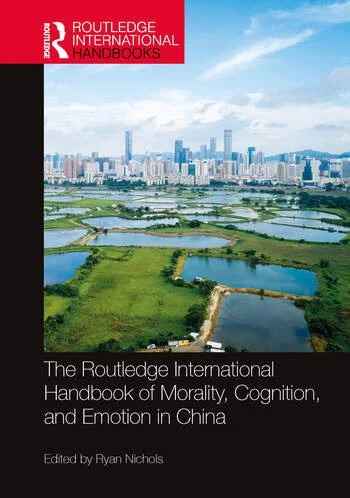
The Routledge International Handbook of Morality, Cognition, and Emotion in China
/
Routledge, 2022
This volume was the product of generous funding from the Templeton World Charity Foundation, which allowed the authors, who come from many very different disciplines and use quite distinct methods, to meet, read, comment on, and discuss our draft papers. Those disciplines range from philosophy, linguistics, history, and law to anthropology, social and developmental psychology, behavioral ecology, and neuroscience. The book's fifteen chapters study morality at the level of the individual person, and together they move past the familiar Western picture of China as a single, monolithic culture. Among the questions they take up: What are the major contours of a distinctively Chinese morality? What role did ancient ecology, climate, and pathogen load play in shaping Chinese moral attitudes and emotions? Are the ingredients of a good life in China different from those elsewhere? How are children in China morally educated? What can cultural neuroscience tell us about how people in China and elsewhere treat family members and strangers?
The chapters move from models, through distal and subpersonal factors, to cultural and historical factors, development, and moral change. Michael H. Bond proposes a social psychological model of the situated morality of the Chinese and other cultural groups. Takeshi Hamamura analyzes Chinese morality in light of latitude, pathogens, agriculture, and modernization, and Shihui Han brings cultural neuroscience to bear on moral judgment in East Asia. Edward Slingerland draws on cognitive science to defend habit in early Confucian virtue ethics, Perry Link examines language and morality in Chinese culture, and Yunxiang Yan traces trajectories of moral transformation in contemporary China. Jeffrey Wasserstrom asks whether the Hong Kong protests carry on, or break from, the ethics of protest in historical China. Chapters by Yiyi Wang and Yanjie Su, John Head, Liqi Zhu and Yingjia Wan, Jing Xu, Emma E. Buchtel, Vivian Lun, and Yiming Jing and Huajian Cai take up genetics, law, moral development, the meaning of morality in Chinese and in China, well-being, and the cultural diversity of Chinese morality. My own opening chapter makes the case that multidisciplinary research is essential to understanding Chinese morality.
Nichols, R. (2015). Dao 14: 499-520. DOI: 10.1007/s11712-015-9464-8